


On Asian Ingredients and Home Remedies
- Dec 7, 2023
- 4 min read
Updated: Jan 13, 2024
A boon to the human body

(Source: Pexels)
In Asia, from household to household families have a long generation of home remedies from natural ingredients passed down from generation. These home remedies are so effective that they have been scientifically proven. In India, Ayurveda is still practiced today. To put it simply, the ancient medicinal practice aims to heal from the inside out – a holistic approach to wellness that touches on the body, mind, and soul.
Similarly, People from other Asian countries like South Korea, Japan, China, and Taiwan are known to have flawless skin because they have these nutrient-rich natural plant-based ingredients in their day-to-day diets. So we have listed some of the main ingredients for quick home remedies.
1. Adzuki Bean

(Source: Unsplash)
Japanese women have been adding beans to their beauty routines since the 18th century. After harvesting the pod, women ground them into a powder, placed them in a silk bag, and scrubbed it against their face and body. The little beans are full of manganese, an antioxidant powerhouse that works to find free radicals in the body and neutralize harmful particles.
Usage:
Adzuki beans contain a natural foaming agent called saponin that helps cleanse pores by removing dirt and dead skin cells, drawing out impurities, and promoting circulation. Products made with adzuki beans are great for those prone to acne and blackheads.
Other Benefits:
Antioxidant benefits, Prevent Diabetes, Gastrointestinal Issues, Brain Function, Reduced PMS Symptoms, Strong Bones and Teeth
2. Camellia oil or Tsubaki oil
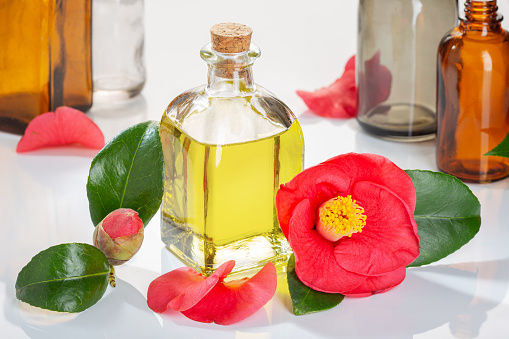
Camellia japonica, also known as Tsubaki in Japanese is a flowering tree indigenous to Japan and China, and a member of the tea family. Camellia oil is harvested from the seeds of the plant and is traditionally known for its remarkable ability to retain moisture and penetrate the deepest layers of the skin which prevents the skin from drying out.
Benefits:
Japanese Camellia oil is a rich source of Palmitic and Omega-6 Linoleic fatty acids, as well as numerous anti-aging polyphenol antioxidants. It is non-greasy and an excellent all-around moisturizer for the skin as well as for hair.
Camellia oil is an excellent emollient for keeping skin & hair moist & supple. 82% of its fatty acids are composed of Omega-9. Camellia oil is an excellent emollient for keeping skin and hair moist and supple. Camellia oil absorbs very quickly. It permeates deep into lower layers of skin, promoting cell growth, and giving skin support and flexibility.
Japanese women are often praised for having long, lustrous, and shiny hair, one of the main beauty ingredients used by the Japanese to preserve and improve their beautiful hair is nothing more than Tsubaki oil because of its hair care properties.
3. Rice bran

(Source: Pixabay)
Rice bran has been used for centuries in Japan as a key ingredient in cleansers, masks, toners, and bathing powders to keep skin smooth and supple. The versatile, gentle oil extracted from rice bran effectively reduces signs of aging while soothing, hydrating, and protecting the skin. Gamma-oryzanol, a unique, very rare component, particularly helps promote circulation to effectively even skin tone.
Rice Bran Oil is derived from the hard, outer layer of rice which is the bran. Bran, a byproduct of rice milling, is the layer that lies under the chaff, or husk. After being harvested, the bran is either pressed by hand or cold-pressed through machinery to obtain the oil.
Benefits:
Rice bran contains high levels of Vitamins B and E, and is an excellent hydrating agent and anti-ager. It also contains squalene, which occurs naturally in human sebum. Rice Bran Oil’s fatty acids and other nutrients, meanwhile, provide excellent anti-aging properties while protecting against environmental pollution and UV rays. Powerful but easily absorbed, Rice Bran Oil provides serious hydration without clogging pores.
4. Fuller's Earth or Multani Mitti

(Source: Unsplash)
Fuller's earth is any clay material that can decolorize oil or other liquids without the use of harsh chemical treatment. It is called "Multani Mitti", named after the city of Multan, in modern-day Pakistan, the area of its origin. The use of Fuller's earth across the Indian subcontinent dates back to at least 1879.
Benefits:
It is commonly used in homemade face packs. It is rich in magnesium chloride. It deep cleanses your skin, removes whiteheads and blackheads, and diminishes pore size.
5. Turmeric

(Source: Pixabay)
Turmeric was first used in Chinese and Ayurvedic medicine (as a treatment for inflammatory conditions) and then incorporated to use in cooking and beauty rituals around the world. Coming from the ginger family, this spice was used daily in India for at least 6000 years as a cooking spice, perfume, textile dye, medicine, and beauty care.
Usage:
Turmeric contains antioxidants and anti-inflammatory components. These characteristics may provide glow and luster to the skin. Turmeric may also revive your skin by bringing out its natural glow. Many Indians use turmeric packs for their skin treatment which can include the mixing of a tablespoon of sandalwood, a teaspoon of cream, a few tablespoons of gram flour, and a pinch of olive oil. This pack has been known to work the best for adding moisture back to your skin.
Benefits:
The main benefits of turmeric include brightening and restoring the moisture of your skin thus further smoothening your skin conditions, and act as an antimicrobial, anti-inflammatory, and antioxidant agent.
6. Aloe Vera

(Source: Pexels)
Aloe vera trade routes were well-established in the Red Sea and Mediterranean regions as far back as the 4th century BC. The leaves of Aloe vera are succulent and erect and form a dense rosette. Many uses are made of the gel obtained from the plant’s leaves.
Usage:
Aloe vera is used on facial tissues where it is promoted as a moisturizer and anti-irritant to reduce chafing of the nose. Cosmetic companies and brands commonly add sap or other derivatives from Aloe vera to products such as makeup, tissues, moisturizers, soaps, sunscreens, incense, shaving cream, or shampoos.
Benefits:
Aloe vera contains enzymes called proteolytic enzymes which repair dead skin cells on the scalp. It also acts as a great conditioner and leaves your hair all smooth and shiny. It promotes hair growth, prevents itching on the scalp, reduces dandruff, and conditions your hair.

(Source: Pexels)
So to conclude, I would like to convey that as we integrate these home remedies into our skincare routines, let's remember that beauty is not just skin deep; it's a reflection of our overall health and well-being. Embrace the authenticity of home remedies, savor the journey to healthier skin, and revel in the beauty that nature, in all its simplicity, has to offer.
Cheers to radiant, naturally glowing skin, courtesy of the wonders found right within the heart of our homes!


Comments